What Is the Best Container Insulation Type in 2026?
Choosing the best container insulation in 2026 requires more than comparing R-values. A container faces steel walls, narrow cavities, condensation, vibration, and sharp temperature changes. Its insulation must perform inside a moving, sometimes unforgiving environment.
Dr. Mark Bomberg, a respected insulation researcher, has emphasized a practical principle: “Insulation performance depends on the whole system, not only the material.” That idea matters inside shipping containers. Closed-cell spray foam can seal irregular joints and reduce air leakage. PIR panels offer strong thermal performance with limited thickness. Mineral wool provides useful fire resistance, but it needs careful moisture protection. Reflective foil may help, although it cannot replace a properly sealed insulation layer.
There is no universal winner.
Field experience often favors a hybrid design. Rigid PIR panels can cover broad steel surfaces. Spray foam can close corners, seams, and difficult penetrations. A continuous thermal break may reduce cold bridging around frames and doors. Yet installation quality remains decisive. A small unsealed gap can create a cold stripe, collect moisture, and damage stored goods over time.
The best choice depends on climate, cargo, internal heating, budget, and expected service life. A refrigerated container needs a different strategy from a site office or mobile workshop. Even excellent insulation can fail when water enters behind the lining. That is an easy detail to underestimate.
This guide compares leading container insulation types for 2026. It considers thermal efficiency, moisture control, fire behavior, durability, installation difficulty, and total cost. Some conclusions remain imperfect. Real projects vary, and laboratory ratings do not always predict field performance.
What Container Insulation Is and Why It Matters in 2026
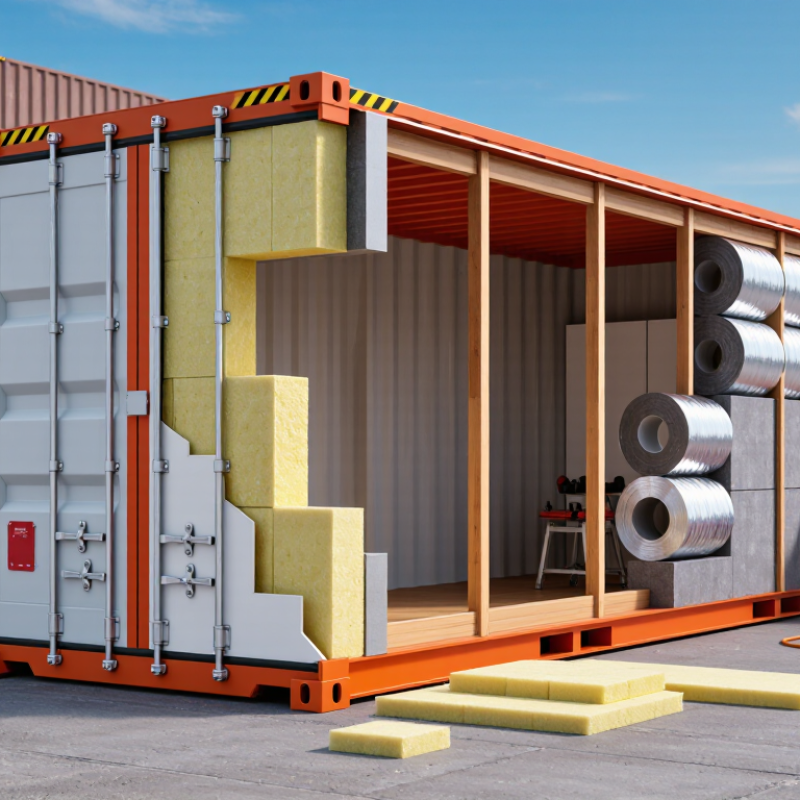
Container insulation is a thermal barrier that slows heat transfer through walls, roofs, floors, doors, and joints. Think of it as a winter coat around a steel box. Without it, steel quickly absorbs summer heat and releases indoor warmth during cold nights. The best insulation type in 2026 depends on the container’s purpose, climate, moisture exposure, and budget. Rigid PIR and closed-cell polyurethane panels usually offer strong thermal resistance with limited thickness. Mineral wool provides useful fire and acoustic performance, but it needs careful moisture protection. Vacuum insulated panels perform impressively in tests, yet punctures can destroy their advantage. That trade-off matters.
The need is measurable.
FAO’s 2022 food-loss report estimated that 13.2% of food was lost between harvest and retail globally. Poor thermal control can accelerate spoilage during storage and transport. The International Energy Agency also projects cooling demand could more than triple by 2050 without efficiency improvements. Better insulation reduces the workload on cooling equipment, especially in sunlit yards and warm ports. UNEP’s 2024 buildings report reinforces the wider issue: buildings consumed about 32% of global energy in 2022. Containers are smaller, but the physics remains similar.
In practice, insulation thickness alone is not enough. A thicker wall can still perform poorly. Field inspections often find gaps around doors, floor rails, fasteners, and service penetrations. Moisture then enters, condenses, and weakens performance. ISO 1496-2 provides relevant requirements for thermal containers, but installation quality still decides much of the outcome. For most general-purpose conversions, closed-cell foam or rigid PIR panels offer a practical balance. I would not choose blindly. The “best” material can fail when seals, ventilation, drainage, and thermal bridges receive less attention.
How Major Container Insulation Types Work
What Is the Best Container Insulation Type in 2026?
How Major Container Insulation Types Work
Container insulation controls heat flow through conduction, convection, radiation, and moisture movement. Rigid foam boards, including expanded or extruded polystyrene, trap air inside closed cells. This slows heat transfer through walls, floors, and ceilings. Polyurethane panels provide stronger insulation in thinner layers. That matters when interior space is limited. However, careless cutting can leave gaps around doors, corners, and steel frames.
Spray foam expands into irregular spaces and can reduce air leakage effectively. It needs careful application, because uneven thickness creates weak thermal areas. Mineral wool resists heat and offers useful fire performance, but it can absorb moisture without a proper vapor-control layer. Reflective foil works differently. It reflects radiant heat, yet it performs poorly when pressed directly against another surface. An air gap is essential.
Vacuum insulated panels deliver excellent thermal resistance with minimal thickness. They are expensive and vulnerable to punctures during installation. A damaged panel may lose much of its performance. In real container projects, the best result often combines rigid insulation, sealed joints, a raised floor, and controlled ventilation. Condensation remains the difficult detail. Warm indoor air can meet cold steel behind the insulation, forming hidden moisture. I would not choose insulation by its advertised R-value alone. Installation quality, local climate, interior humidity, and future repairs can change the result. A small inspection camera can reveal problems that a clean wall conceals.
What Is the Best Container Insulation Type in 2026?
Thermal conductivity is shown below in representative midpoint values at approximately 20°C. Lower values indicate better insulation performance per unit thickness.
How the major types work: Closed-cell spray foam and rigid PIR/PUR boards generally provide the lowest thermal conductivity, making them strong choices where interior space is limited. XPS and EPS boards offer consistent performance with good moisture resistance, while mineral wool and fiberglass provide effective insulation with strong acoustic and fire-performance characteristics. The best option also depends on moisture exposure, fire requirements, installation quality, durability, and budget.
How to Compare Thermal Performance, Cost, and Durability
What Is the Best Container Insulation Type in 2026?
Choosing container insulation requires more than comparing advertised R-values. Closed-cell spray foam can reduce air leakage and seal irregular steel surfaces effectively. Rigid PIR or PUR boards often provide strong thermal performance with predictable thickness. Mineral wool offers useful fire resistance, but it needs careful moisture protection inside a steel container. Reflective foil is inexpensive, yet it needs a sealed air gap to work properly.
Real-world performance depends on installation quality. A small gap around a floor joint can create condensation, even when the wall insulation looks excellent. In retrofit projects, I would compare the complete assembly’s U-value, not only the insulation’s rating. Cost should include framing, vapor control, labor, ventilation changes, and future repairs. Durable systems tolerate movement and occasional impact better. However, rigid boards can lose effectiveness when joints open. Spray foam can be difficult to remove or repair. Neither option is perfect.
Tips: Request thickness-specific thermal data, inspect seams carefully, and calculate usable interior space. Check local fire and building requirements before installation. Keep a small sample of each material for future identification. A cheaper quote may hide preparation work. Ask for moisture-control details, not just an insulation price. Test the finished container during hot and cold periods. Condensation patterns often reveal weaknesses that drawings miss.
What Is the Best Container Insulation Type in 2026? - How to Compare Thermal Performance, Cost, and Durability
Typical performance ranges for protected insulation systems used on shipping and storage containers. Actual results depend on thickness, installation quality, thermal bridges, moisture exposure, ventilation, and local labor prices.
| Insulation Type |
Typical Thermal Conductivity
(W/m·K) |
Approx. R-Value per 25 mm
(m²·K/W) |
Typical Installed Cost
(USD/m², 2026) |
Thermal Performance |
Moisture Resistance |
Expected Service Life
(When Protected) |
Fire Behavior |
Key Advantages |
Main Limitations |
| Expanded Polystyrene (EPS) |
0.032–0.038 |
0.66–0.78 |
$15–$30 |
Good |
Moderate |
25–50 years |
Combustible; requires a suitable thermal barrier |
Low purchase cost, lightweight, easy to cut and install |
Can absorb moisture at joints or damaged edges; lower insulation value than premium foams |
| Extruded Polystyrene (XPS) |
0.029–0.036 |
0.69–0.86 |
$25–$45 |
Good to Very Good |
Very Good |
30–50+ years |
Combustible; requires a suitable thermal barrier |
Closed-cell structure, good moisture resistance, strong compressive performance |
Combustible, higher cost than EPS, and vulnerable to some solvents and high temperatures |
| Polyurethane (PUR) / Polyisocyanurate (PIR) |
0.022–0.028 |
0.89–1.14 |
$35–$65 |
Excellent |
Very Good |
25–40+ years |
Combustible; PIR generally has better fire performance than PUR |
High insulation value with relatively thin panels; suitable where interior space is limited |
Higher cost, joints must be carefully sealed, and foam performance can decline with aging |
| Mineral Wool |
0.034–0.041 |
0.61–0.74 |
$25–$50 |
Good |
Moderate |
30–50+ years |
Non-combustible; can provide strong fire resistance when correctly installed |
Excellent fire performance, sound absorption, and dimensional stability |
Heavier than foam, needs protection from persistent moisture, and may require more framing depth |
| Closed-Cell Spray Polyurethane Foam |
0.024–0.030 |
0.83–1.04 |
$40–$80 |
Excellent |
Very Good |
25–40+ years |
Combustible; normally requires a code-compliant protective covering |
Reduces air leakage, conforms to irregular surfaces, and limits condensation when properly designed |
Requires skilled installation, difficult to remove, and expansion or substrate problems can affect quality |
| Vacuum Insulation Panels (VIPs) |
0.004–0.008 |
3.13–6.25 |
$150–$300 |
Exceptional |
Good if Sealed |
15–30 years, depending on envelope integrity |
Depends on the panel core and protective facing |
Highest thermal resistance where installation thickness is severely restricted |
Very expensive, cannot be cut on site, and punctures or compression can cause major performance loss |
| Aerogel Blanket |
0.013–0.018 |
1.39–1.92 |
$80–$180 |
Very Good |
Good |
30+ years when protected |
Varies by facing and product composition; many versions resist high temperatures |
Thin, flexible, and useful around difficult details or thermal bridges |
High material cost, lower stiffness, and usually less cost-effective for large container walls |
Practical comparison: For most 2026 container projects, PIR or closed-cell spray polyurethane offers the best balance of thermal performance, space efficiency, and durability. EPS is usually the lowest-cost option, mineral wool is preferred when fire resistance is the priority, and VIPs are reserved for applications where maximum insulation is required in the smallest possible thickness.
How to Choose the Best Container Insulation for Your Needs
What Is the Best Container Insulation Type in 2026?
Choosing the best container insulation begins with the container’s real working conditions. A dry storage unit needs less protection than a living or refrigerated space. Consider outdoor temperature, humidity, ventilation, interior height, and expected service life. Rigid foam panels preserve more internal space, while spray foam can seal awkward joints and metal corners. Mineral wool offers strong fire resistance, but it needs careful moisture control. Reflective foil helps in sunny climates, though it cannot replace substantial insulation.
Tips: Check the container floor, roof, and door seals before selecting materials. Measure thermal bridges around steel frames. Ask an experienced installer for a condensation assessment. Confirm local fire and building requirements. Small gaps matter.
In practical site reviews, moisture often causes more trouble than low insulation values. A warm interior beside cold steel can create hidden condensation. A vapor-control layer may help, but the wrong placement can trap water. That detail deserves professional review. My first instinct would be to choose the thickest material, yet that can reduce usable space and complicate wiring. Budget matters too. Installation quality usually affects performance more than a perfect product specification. Request product data, installation records, and clear maintenance guidance. Test the space after installation with a basic humidity meter. A slightly uncomfortable truth: insulation alone cannot fix poor ventilation.