
7 Best Transport Containers for Global Buyers in 2026

Choosing the right transport containers can protect cargo, reduce handling delays, and make purchasing costs easier to forecast. Yet “best” depends on what you ship, where it travels, and how often the container will be reused. A dry container may suit boxed goods, while temperature-sensitive products call for carefully specified insulation or refrigeration. Fragile equipment may need interior restraints, not just a strong outer shell. Details matter.

This 2026 guide compares seven practical container options for global buyers, from standard steel units to specialized and reusable designs. It considers usable dimensions, payload limits, door access, ventilation, stacking requirements, and compatibility with common handling equipment. Buyers should also review material specifications, inspection records, repair support, and clear supplier documentation before placing an order. A low purchase price can look attractive, but it may not reflect cleaning, maintenance, or return-transport costs.

No option fits all. Route, climate, cargo shape, and storage conditions can change the decision. Even a well-built container can perform poorly when loading plans are rushed or specifications are assumed. That point is easy to overlook. The recommendations ahead are intended as a careful starting point, not a substitute for checking the exact model against your shipment and operating conditions. Compare the details, ask suppliers specific questions, and leave room for the occasional surprise.
7 Best Transport Containers for Global Buyers in 2026

How ISO 668 Defines the 20-Foot TEU and 40-Foot FEU Baseline

7 Best Transport Containers for Global Buyers in 2026

How ISO 668 Defines the 20-Foot TEU and 40-Foot FEU Baseline

ISO 668 provides the common dimensional language behind international container planning. A standard 20-foot unit measures about 6.058 meters long, 2.438 meters wide, and 2.591 meters high externally. This unit is called one TEU, or Twenty-foot Equivalent Unit. A 40-foot unit uses the same width and height, but reaches about 12.192 meters long. It represents one FEU, or two TEUs.

The difference looks simple. Operations are not. A 40-foot container does not always carry twice the usable weight. Cargo density, floor loading, door clearance, and local road limits change the result. Internal dimensions also vary by container type and manufacturing tolerances. I still recheck these details before approving a loading plan. Small errors become expensive delays.

UNCTAD’s Review of Maritime Transport 2024 recorded global seaborne trade of approximately 12.3 billion tonnes in 2023. Its data also showed continued growth in container shipping capacity. That pressure makes standardization valuable for freight forecasts and port handling. The World Bank’s Logistics Performance Index 2023 also highlighted tracking, timeliness, and infrastructure as major logistics performance factors. ISO 668 supports the first planning step, but it cannot replace a verified cargo drawing. Measure the goods. Check the route. Then select TEU or FEU capacity with some humility.

Seven Container Types Matched to Cargo, Capacity, and Global Trade Routes

7 Best Transport Containers for Global Buyers in 2026

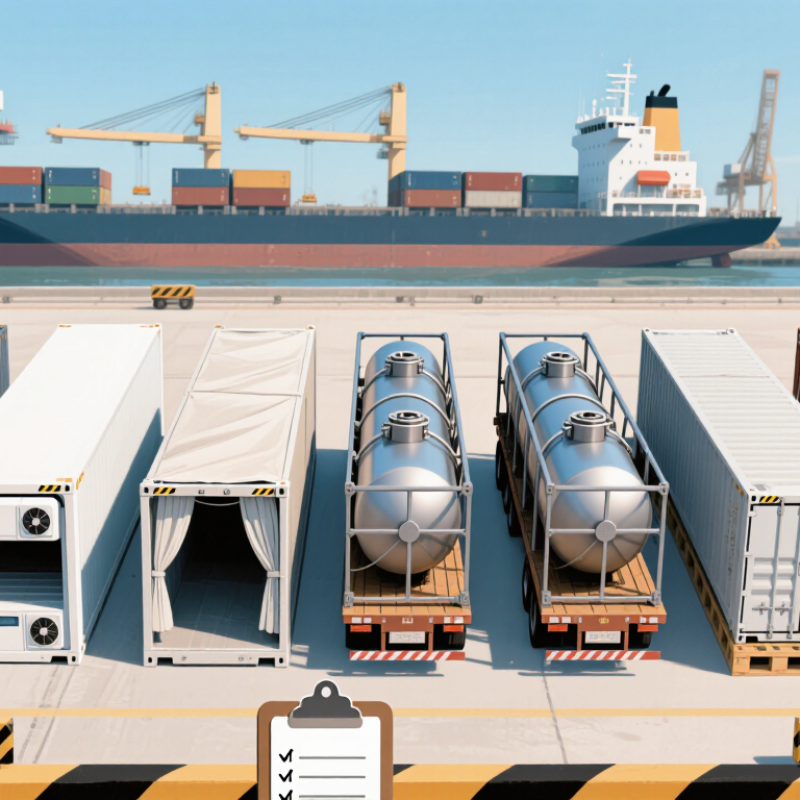
Seven container types should be matched to cargo, capacity, and trade routes. Standard dry containers suit boxed goods, machinery, and most general freight. Choose 20-foot units for dense cargo, or 40-foot units for higher volume. High-cube containers add internal height for furniture, packaging, and lightweight equipment. Routes matter. UNCTAD’s Review of Maritime Transport 2024 recorded 2.4% growth in global seaborne trade during 2023, increasing pressure on space and reliable equipment planning.

Refrigerated containers protect seafood, produce, and temperature-sensitive medicines, but power interruptions remain a practical risk. Open-top containers handle tall machinery and bulk materials loaded by crane. Flat racks support oversized equipment, though lashing and route clearance require expert checks. Tank containers transport approved liquid cargo under controlled specifications. Ventilated containers help selected agricultural goods that need airflow, not refrigeration. Insulated containers offer steadier temperatures for moderate conditions. I would not pretend one type fits every shipment. The World Bank’s Logistics Performance Index 2023 shows major differences in customs, infrastructure, and delivery reliability between trading economies. Check port handling, inland bridges, seasonal weather, and transshipment points before booking. Measure twice. A cheaper container can create costly delays.

7 Best Transport Containers for Global Buyers in 2026 — Seven Container Types Matched to Cargo, Capacity, and Global Trade Routes

Container Type Typical Internal Dimensions (L × W × H) Approx. Capacity Best-Suited Cargo Route and Planning Considerations
20 ft Standard Dry 5.90 × 2.35 × 2.39 m About 33 m³; payload commonly around 28 t, subject to the container’s rating and local limits Dense, palletized, or boxed cargo; machinery, metals, and bagged goods A versatile choice for port-to-port and inland moves when cargo is relatively heavy but does not need much volume. Check road axle-weight limits on the destination leg.
40 ft Standard Dry 12.03 × 2.35 × 2.39 m About 67 m³; payload commonly around 26–27 t, subject to equipment rating and local limits General merchandise, furniture, textiles, and other high-volume, non-temperature-controlled cargo Common on major intercontinental ocean services, including Asia–Europe and trans-Pacific lanes. Confirm that the cargo’s weight and loading pattern suit the payload limit.
40 ft High-Cube Dry 12.03 × 2.35 × 2.69 m About 76 m³; payload commonly around 26–27 t, subject to equipment rating and local limits Light, bulky cargo such as packaged consumer goods, appliances, and furniture Useful on long-haul ocean routes when extra vertical space improves cube utilization. Verify overall height restrictions for rail, road, and warehouse access.
40 ft High-Cube Reefer Approximately 11.6 × 2.29 × 2.55 m Roughly 67–68 m³ of internal space; usable payload depends on reefer tare weight and rated limits Temperature-sensitive food, pharmaceuticals, and other goods requiring controlled conditions Suitable for refrigerated ocean services on routes such as produce-export lanes and other temperature-controlled supply chains. Allow for power connections, pre-trip inspection, temperature settings, and monitoring.
20 ft Open-Top Approximately 5.90 × 2.35 × 2.35 m; dimensions vary by design About 32 m³; payload depends on the unit’s rating Over-height or top-loaded cargo, including certain machinery, timber, and large industrial parts Can be considered where cargo is loaded from above at origin or destination. Confirm lashing, weather protection, loading clearance, and any out-of-gauge handling requirements before booking.
40 ft Flat Rack Deck length about 12.1 m; deck width about 2.4 m; no fixed side or roof dimensions Payload varies substantially by model; some heavy-duty units are rated near 40 t Oversized or heavy cargo such as vehicles, industrial equipment, and project cargo Used for cargo that exceeds standard container dimensions on major project and industrial trade routes. Obtain carrier approval and confirm securing, lifting points, route clearances, and out-of-gauge charges.
20 ft ISO Tank Frame length about 6.06 m; tank dimensions and fittings vary by specification Typically around 21,000–26,000 L; permitted payload depends on tank rating, product density, and regulations Bulk liquids, food-grade liquids, and certain approved hazardous or non-hazardous chemicals Appropriate for liquid supply chains using compatible tank equipment and handling facilities. Check product compatibility, cleanliness, temperature needs, loading limits, and dangerous-goods rules.

Planning note: Dimensions and capacities are indicative industry ranges, not guaranteed specifications. Actual internal measurements, tare weight, payload, and permitted gross mass vary by unit, manufacturer, carrier, cargo, and jurisdiction. Always verify the container data plate and applicable transport limits before shipment.

How CSC 1972 Plates and ISO 1496 Tests Protect International Shipments

7 Best Transport Containers for Global Buyers in 2026

More than 80% of global merchandise trade moves by sea, according to UNCTAD’s Review of Maritime Transport 2024. That statistic makes container safety more than a purchasing detail. The CSC 1972 plate confirms that a container passed required structural checks and remains eligible for international transport. Buyers should verify the container number, maximum gross mass, inspection date, and plate condition before loading.

ISO 1496 testing examines stacking strength, lifting points, floor performance, wall pressure, and weather resistance. These tests simulate harsh handling, including crane lifts, vessel movement, and repeated transfers between trucks and terminals. A valid plate helps, but it does not guarantee a dry floor. Small roof dents can become leaks during heavy rain. Paperwork can also lag behind physical damage.

The World Shipping Council has reported that millions of containers move through global supply chains each year, with only a small fraction involved in serious incidents. Still, risk concentrates around neglected equipment. A practical inspection should check door gaskets, corner castings, welds, locking bars, and visible corrosion. Photographs are useful evidence. So are recent examination records.

Some buyers focus too heavily on capacity. That is understandable, but incomplete. A container may fit the cargo and still fail at the port gate. Specification sheets can look perfect. Reality is less tidy. Fresh inspection evidence, compatible handling equipment, and accurate cargo weight remain essential for international shipments.

7 Best Transport Containers for Global Buyers in 2026

Typical internal capacity comparison for widely used ISO container types. Actual dimensions and usable volume vary by specification, insulation, doors, and operating equipment.

CSC 1972 safety approval plates identify key limits such as maximum gross mass and approved stacking or racking values. ISO 1496 tests cover critical performance areas including stacking, lifting, floor strength, racking, and weather-tightness, helping buyers verify that containers are suitable for international transport.

Capacity figures are representative values in cubic metres based on common ISO container dimensions. Reference framework: CSC 1972 Convention and ISO 1496 freight-container testing standards.

Reefer Containers: Maintaining Cargo Temperatures from −30°C to +30°C

Reefer containers protect temperature-sensitive cargo across long international routes. Their operating range can reach approximately −30°C to +30°C, depending on the equipment and cargo profile. Frozen seafood may require −18°C or lower, while fresh produce often needs controlled temperatures above freezing. The set point alone is not enough. Air circulation, humidity, loading patterns, and door openings also affect cargo quality.

FAO’s The State of Food and Agriculture 2019 estimates that 14% of food is lost between harvest and retail. Reliable cold-chain transport can reduce part of this loss, although it cannot repair poor harvesting or packaging.

Drewry’s Reefer Shipping Annual Review and Forecast 2024 also highlights continued demand for temperature-controlled maritime transport. Global buyers should compare temperature stability, power compatibility, remote monitoring, and service support at destination ports. Cheaper equipment can become expensive after one failed shipment.

Tips: Pre-cool the cargo before loading. Keep airflow channels clear. Use calibrated data loggers inside the load, not only the container display. Check the temperature history after arrival. A sealed door is not proof of safe cargo. Small loading mistakes still happen, even with experienced teams. Temperature records should match the product specification and transport contract.

A 2026 Buyer Checklist for Cost, Payload, Durability, and Compliance

7 Best Transport Containers for Global Buyers in 2026

A practical 2026 checklist starts with the cargo, not the container’s appearance. The seven useful choices include rigid plastic boxes, steel units, aluminum cases, pallet boxes, collapsible containers, insulated containers, and reusable bulk vessels. Select the format that protects the product and fits your handling equipment. A lower tare weight can improve payload, but only when the container remains stable during lifting and stacking.

Calculate total cost, not only the purchase price. Include freight, storage, cleaning, repairs, return transport, and disposal. A collapsible unit may save warehouse space, while a rigid unit may survive rough handling better. Check internal dimensions carefully. A few wasted centimeters can force extra containers. I have seen buyers overlook empty-return costs. That mistake becomes expensive quickly.

Durability needs practical testing. Inspect corners, hinges, latches, seals, wheels, and fork openings. Ask for load ratings, test records, material details, and maintenance guidance. Compliance also requires careful verification. Confirm destination rules for dimensions, labeling, wood components, food contact, temperature control, and transport documentation. Requirements can vary by route and cargo type. Never assume one certificate covers every market. The safest choice may not be the strongest container. It is the one with traceable specifications, predictable handling, and a documented inspection process. Some estimates will still be imperfect. Recheck them with real shipment data.

Go to Top