What Are the Top Large Shipping Container Types in 2026?
In 2026, choosing a large shipping container is less about picking the biggest box and more about matching cargo, handling, and route. A 40-foot high-cube unit adds vertical space for cartons, furniture, or equipment that cannot be stacked tightly. A 45-foot high-cube container offers more floor length where carriers and terminals accept it. Availability matters. Dimensions, door openings, tare weight, and payload can vary by manufacturer and specification, so a container’s label alone does not settle the choice.
Other large formats solve specific problems. Refrigerated containers support temperature-sensitive cargo but require power and careful temperature planning. Open-top units make overhead loading easier for tall machinery; flat racks can accommodate unusually wide or heavy cargo, within equipment limits. Side-opening designs improve access to long loads, although extra doors may affect price and availability. None is automatically best. That sounds obvious, yet buyers sometimes focus on capacity before checking how cargo will be loaded.
This guide compares leading large shipping container types for 2026 by usable dimensions, cargo fit, access, and practical trade-offs. It also considers when a standard dry container may be the more dependable option. Confirm internal measurements and allowable payload with the supplier before booking. A tape measure helps. So does asking how the cargo will be loaded and secured. The right choice is not always the largest one; sometimes the extra space is simply wasted.
ISO 668 Size Classes: A 40-ft Container Equals 2 TEU
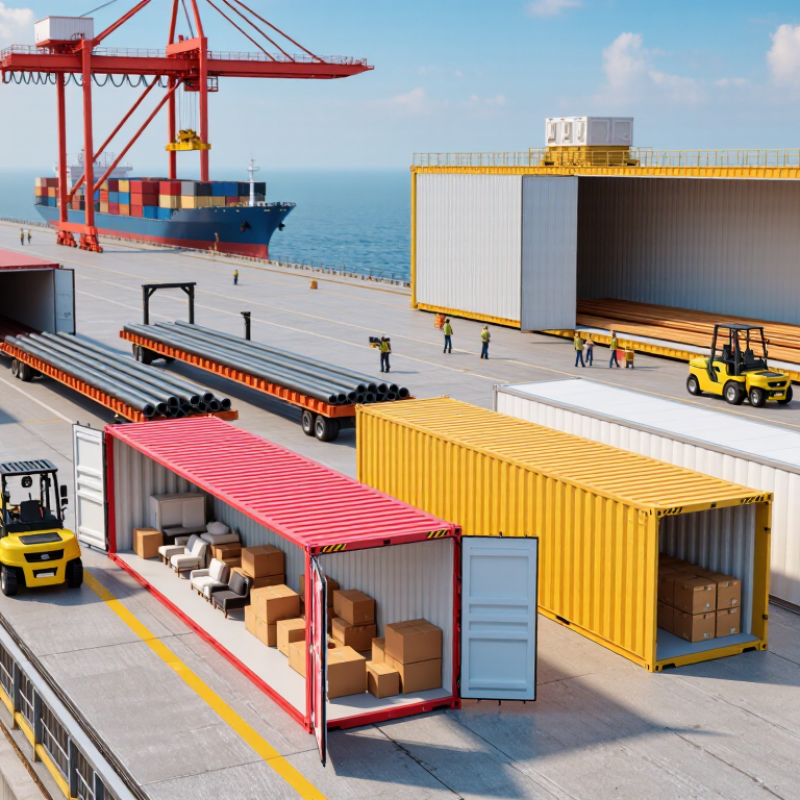
ISO 668 provides the dimensional framework for freight containers, including widely used 20-foot and 40-foot units. A 40-foot container is counted as 2 TEU, or two twenty-foot equivalent units. This helps ports, carriers, and planners compare capacity using a common measure.
But TEU is a planning unit, not a promise of twice the usable space. A 40-foot dry container typically shares the standard footprint of other 40-foot types, while a high-cube version offers extra height. That added space matters for light, bulky cargo. A reefer has insulated walls and cooling equipment, which reduce its interior room. Small details count.
The ratio is useful, but it can mislead. A 40-foot box is not exactly twice as long as every 20-foot box, and door openings, payload limits, and cargo shape affect loading. On a yard plan, two TEU may look simple; at the loading bay, pallet layout can change the result. For reliable estimates, check the container’s stated dimensions and maximum gross mass, not TEU alone. I would also leave a little room for uncertainty: real cargo rarely stacks as neatly as a diagram.
Top Large Shipping Container Types in 2026
Compare nominal external length with TEU capacity across common ISO 668 container sizes.
ISO 668 size classes standardize container dimensions. A 40-ft container equals 2 TEU; a 45-ft container is 2.25 TEU. High-cube containers share the same nominal length as standard-height containers but are taller.
40-ft Standard Dry Containers: 12.19 × 2.44 × 2.59 m Externally
A 40-ft standard dry container measures
12.19 × 2.44 × 2.59 m
externally. These dimensions describe the outside, not the clear space available for cargo. Wall panels, floor thickness, and door framing reduce the usable interior. Exact internal measurements vary slightly between units, so check the container’s specification plate or measure the actual unit before planning a tight fit.
That distinction matters.
A pallet that fits neatly on a drawing may leave too little room beside the doors for loading equipment. Measure twice. Also consider the route into the site: a container may fit the cargo plan but still be awkward to position near a loading bay or under overhead structures. The external width is about 2.44 m, yet access clearance needs extra space. A tape measure and a simple floor plan can prevent costly rearranging. I have seen planning focus on cargo dimensions while overlooking door access; it is an easy mistake, and a useful reminder that nominal size is only a starting point.
40-ft High-Cube Containers: 2.90 m External Height for Extra Volume
A 40-ft high-cube container is about 2.90 m tall externally, roughly 30 cm taller than a standard-height model. That extra height creates more cubic capacity without increasing the container’s footprint. It can help when loading light, bulky goods such as furniture, boxed displays, or insulation panels. Useful extra headroom.
The outside measurement is not the usable interior height. Roof beams, flooring, and door dimensions reduce the available clearance, so check the container’s specification sheet before planning a load. Measure the tallest item with its pallet and packaging included. A shipment may fit inside but still fail to pass through the doorway.
The added volume does not automatically mean more payload. Container tare weight and rated limits vary, and heavy cargo can reach its weight limit before filling the space. Check the rating plate and calculate the load by both volume and weight. It is easy to overestimate the benefit from the headline height alone; a little extra measuring can prevent a costly mismatch.
What Are the Top Large Shipping Container Types in 2026? — 40-ft High-Cube Containers: 2.90 m External Height for Extra Volume
| Container type |
External dimensions (L × W × H) |
Approx. internal dimensions (L × W × H) |
Approx. internal volume |
Typical use |
| 40-ft standard dry |
12.19 × 2.44 × 2.59 m |
12.03 × 2.35 × 2.39 m |
67.7 m³ |
General cargo that fits within standard container height. |
| 40-ft high-cube dry |
12.19 × 2.44 × 2.90 m (nominally 2.896 m) |
12.03 × 2.35 × 2.70 m |
76.3 m³ |
Light or bulky cargo; offers about 9 m³ more internal space than a 40-ft standard dry container. |
| 45-ft high-cube dry |
13.72 × 2.44 × 2.90 m |
13.56 × 2.35 × 2.70 m |
About 86 m³ |
Long, voluminous cargo requiring more floor length as well as high-cube height. |
| 40-ft high-cube refrigerated |
About 12.19 × 2.44 × 2.90 m |
About 11.6 × 2.29 × 2.55 m |
About 67–68 m³ |
Temperature-controlled cargo; refrigeration equipment and insulation reduce usable internal space. |
Measurement note: Dimensions and volumes are typical nominal figures. Actual internal measurements and capacity can vary by container design and manufacturer; confirm the specifications of the individual unit before loading.
40-ft Reefers and Open-Tops: Specialized 2-TEU Equipment Types
A 40-foot reefer is a 2-TEU container with an integrated cooling unit.
It suits temperature-sensitive cargo that needs a controlled atmosphere throughout transit. Air must move beneath and around the load, so blocked floor channels can undermine temperature control. The UNCTAD Review of Maritime Transport 2024 reports that global container-port throughput reached 858.9 million TEU in 2023. That scale highlights how small handling errors can matter across busy supply chains. Still, a reefer is not a magic thermostat; cargo condition and loading practice matter.
A 40-foot open-top also represents 2 TEU, but its removable roof supports top loading of tall or awkward cargo.
A crane can lower items through the opening, while a secured tarpaulin protects the load from weather. Measure cargo height and lifting clearance before booking. Check lashing points and confirm the route can handle the loaded unit. The trade-off is practical: easier top access can mean more exposure during handling. I would not assume every oversized load fits just because the roof opens.
Tips: For reefers, confirm the required set point, airflow space, and pre-trip inspection record. For open-tops, check dimensions, securing arrangements, and cover condition before dispatch. A simple photo can help—but it cannot replace a physical inspection.
45-ft High-Cube Containers: 13.72 m Long and 2.25 TEU by Length
A 45-ft high-cube container measures about 13.72 metres long externally. By length alone, that equals 2.25 TEU, since one TEU represents a 20-ft unit. The comparison is useful, but it does not mean the container holds exactly 2.25 times the cargo of a 20-ft box. Internal dimensions, door openings, cargo weight, and loading patterns all affect usable capacity.
The extra height is another practical feature. A high-cube container is typically about 30 centimetres taller externally than a standard-height container, leaving more room for suitable bulky freight. Measure the cargo before loading; a few centimetres can matter near the doors. That matters. Still, greater volume does not automatically mean more weight can be carried. Check the container’s rating and the transport limits that apply to the planned route.
For a shipment planner, 45-ft units can reduce the number of containers needed for long, relatively light cargo. Their length can also make storage and handling less convenient at some sites. A simple length ratio can mislead: real loading plans depend on cargo shape, stacking rules, and available equipment. I would treat 2.25 TEU as a comparison, not a promise of cargo capacity.